The Red Train
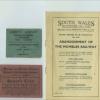
Description
Transcript:
David Gwyn John is my name, and I was born in June 1939 about three months before the beginning of the Second World War. I was born in a terraced house in a little village called Ynysforgan at the bottom of the Swansea Valley. Past the house was the main road and the railway which runs up the valley.
I went to school in the next village, Ynystawe, in 1944. In the infants' there was a reception class and to tell the truth all the infants were together all the time. As we moved to the junior school, even though Welsh was the language of the infants' class, there was no Welsh spoken after that. I had to travel across Swansea town and I'd do this on ordinary public buses. There were no special school buses then.
For some reason, I had a real interest in traffic and I used to spend hours sitting on the wall outside watching the traffic pass and noticing especially the buses from the South Wales Transport company and James of Ammanford, and also United Welsh who had their garage locally in Clydach. And those were my favourites.
What was special about their buses as well was that they had been built during the War and they had hard wooden seats inside. Of course the motor that ran the bus was at the front and there was a platform at the back where the ticket collector or the conductor would stand and perhaps walk around the bus collecting money.
In fine weather, of course, families would go down to Swansea, not only to shop, but to go to the Gower Peninsula or to the Mumbles perhaps. And if they were going to the Mumbles then I'm sure they would go on the Mumbles train from Swansea down to Oystermouth or the Mumbles. It was more of a tram than a train really, and it ran on electricity and every carriage carried 106 passengers. And they usually travelled along the track in pairs so 212 people could travel in seats on each of the trains. People travelled down to the Mumbles or Oystermouth. I'm sure they would enjoy the trip on the train. I used to enjoy it every time. But to get on it, in summer especially, you had to wait in a long queue, and the train would arrive at the station in Rutland Street and everyone would push on, and funnily enough the queue would disappear just like that.
Of course the trip on the train has been immortalised by the poet Bryan Martin Davies in the poem 'Glas' where he talks about the red pencil of a train going along the bay.
About 1959 I heard that the railway, which was such a pleasure for me on the road to the Mumbles, was going to close. But today I'm looking forward to a new type of transport to take people down towards Mumbles, namely a bus which can bend in the middle with doors which open and close, and I'm sure that in the future even things like that will seem old-fashioned.

More items with these tags
This item also appears in


Contact Us
To request take down or report racist, offensive or otherwise harmful content.
You must be logged in to leave a comment