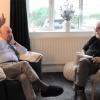
Dennis Aston. National Service. 1956-58. Filmed Interview Part 1
Description
18yrs old Dennis Aston was conscripted into National Service in 1956, serving as a fire fighter in the RAF for the next two years. Looking back some 70yrs ago, Dennis recalls his eventful time in the RAF and concludes (in Part 2) that National Service in the Royal Air Force taught him key life-skills such as respect and discipline and have shaped the way he has lived his life since then. Dennis finishes the interview by saying “I thought it was wonderful.”
This is the first of a two-part interview carried out with Dennis in Sarnau, Ceredigion, on 18th September 1989 for Age Cymru Dyfed's HLF-funded National Service, Wales project which can be found on the West Wales Veterans Archive.
Dennis Aston
National Service 1956-58
Royal Air Force
Interview Date: 18.9.25
Location: Sarnau, Ceredigion
Interviewer: Hugh Morgan
Camerman: Neil Davies
Interview Part 1: Written Description
Dennis Aston’s collection contains a written description, filmed interview, and photographs from Dennis personal collection relating to his National Service.
Dennis was born on 22.5.1937 at No 6 Clifton Street, Northwood, near Hanley, Stoke on Trent. Dennis’ father, Harold, served as a Sergeant in the King’s Shropshire Light Infantry (KSLI) during WW2 before in the post-war years eventually working for the Midlands Electricity Board.
As a child during WW2, Dennis recalled Luftwaffe bombers dropping bombs in the vicinity of his house, destroying shops and allotments. He remembers also watching American bombers flying overhead, on their way to bomb targets in France and Germany.
Dennis received his conscription letter when he was living with his parents who had a grocery shop in Cobridge, a district of Stoke-on-Trent. He met his future wife whilst working as an apprentice in a steel company. As he was 18 at the time and in an apprenticeship, Dennis was eligible for deferment. Upon opening the conscription letter his father said “Oh, you’re going with the Brylcreme Boys are you!”
Dennis decided against deferment and chose to go straight in to the RAF, reporting to RAF Cardington in Bedfordshire. Service no’ 502283. After a week being ‘kitted out’, he was posted to West Kirkby on the Wirral for the next six weeks. Heavily into football and swimming, Dennis played for the ‘Trenchard Squadron’ football team whilst at West Kirby.
Dennis was then posted to RAF Bexhill in Sussex for trade training as a Fireman. During the 1939-45 war Bexhill had been an important radar and had been heavily bombed by the Luftwaffe and by V1 flying bombs. Having qualified, Dennis and the other firemen in his section were taken by bus to a secret underground radar station where they spent three days and nights underground on duty. They quickly discovered that the RAF mess served all the best food, including a ready supply of fruit which had been issued to off-set a lack of vitamin intake which resulted from being out of the sunlight.
As a qualified fireman Dennis was a Leading Aircraftman (LAC). Then, whilst waiting to sit an officer’s entrance exam, he received a posting to RAF Manston in Kent. Deciding that as he wanted to go to Manston rather more than become an RAF officer, he chose to remain an LAC.
Upon arrival at RAF Manston Dennis was surprised to find the American USAF 92 Fighter Squadron stationed there. In fact, the RAF contingent was exceedingly small (32) when compared with the 2500 American personnel on the base (Manston was at the time a USAF Strategic Air Command base for much of the Cold War only handing the station back to the RAF in 1962).
Dennis recalls some of the American aircraft in use at Manston – the T33 Thunderbird, F84 and 86 and 86D Sabres. Manston was one of the few airfields to be equipped during WW2 with FIDO. Then, as it surprisingly turned out, Dennis came to be one of the last people to ever ‘fire-up’ FIDO.
“Fog Investigation and Dispersal Operation” (FIDO) (which was sometimes referred to as "Fog Intense Dispersal Operation") was a system developed originally in Birmingham University to disperse fog and smog from an airfield so that aircraft could safely land., During WW2, Allied aircraft were sometimes unable to safely land at their home station due to fog and would then be diverted to FIDO equipped aerodromes.
FIDO involved the ignition of extensive pipework containing petrol which when lit, produced a row of flame along the side of the runway and therefore warmed the air. The heat from the flames evaporated fog droplets, so that there would be a clearing of the fog directly over the runway. This allowed the pilot to see the ground as he attempted to land. Dennis explains that when it was foggy at Manston any aircraft seeking to land on the aerodrome, flew over and then approached their landing from the Ramsgate direction.
Dennis recalls that a recently arrived RAF Sergeant obtained permission to investigate how FIDO would have worked (and asked the LAC fireman “does anybody here know anything about pipework, valves….” Having previously been an apprentice in the steelworks, Dennis volunteered his services and recalls the process he went through to find out how the FIDO structure worked, then he produced some drawings. He mentions for example that there was around 15miles of pipework to transport the petrol which would then be ignited.
The Sergeant duly obtained permission for FIDO to be fired up (possibly for the first time since or shortly after WW2). Therefore, during the Spring of 1958, Dennis and his section cleaned out the fuel vents along the pipework. On the day of “The Burn” there was no fog just a normal day from a weather perspective. Once ignited Dennis remembers FIDO initially belching out a lot of black smoke before clearing after a few minutes. He describes “The Burn” as a “phenomenal sight” which lasted for 12minutes and consumed 250,000 gallons of ‘contaminated’ aviation fuel. There was clearly method behind the Sergeant’s keenness to get FIDO operating once again, for it meant that the fireman who had been working successfully on FIDO were awarded a FIDO operator certificate, and this along with a lorry driver’s license, meant they were promoted to the rank of Senior Aircraftsman, which came with extra pay.
More items with these tags
This item also appears in

Contact Us
To request take down or report racist, offensive or otherwise harmful content.
You must be logged in to leave a comment