19 Aug 1898, 17 Woodville St, Pontarddulais
Description
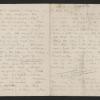
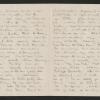
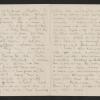
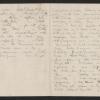
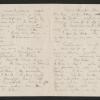
Letter from Edward Thomas to his wife, Helen Thomas. Archival reference: 424/1/1/1/1/67
19/viii'98 17 Woodville Street
My dearest friend,
I was so delighted and surprised this
morning to find another letter from you, and that
so joyful, so forgetful of the slightly clouded
past, that you seemed not to know you had
written an indignant letter only the day before. It
reached me by this mornings first post; since when I have
read it through several times. It is your perfect
ethereal self rising in the azure of health and
love without a cloud; it has it not upon it the wild
scent of passion that stormed in those three sprigs
of heath blossom, - that was too wild. Yet your maiden lovely and beauty were there. I could see your limbs, feel
your hair and the lights in your eyes, I could
taste the odour of your white breast, full
now with womanly health, as you tell me.
10 0 clock Saturday evening
I have just returned: and it has
been a happy time. But I should have been
miserable at once if I had not found your
letter waiting for me. It is true there was a little
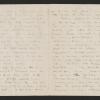
Page two.
hill remarkable for its compactness, shapeliness,,
in shape like a Noah's ark, and very regular though
natural. Fancy attacking it up up such a slope! I
ran up, and nearly died in my panting. - I stood
actually in the window cut out of the 10 foot
thick wall, where the knights formerly aimed their arrows
and (mangonels) [great wooden slings]; they were now
adorned like tombs with the daintiest of pale tufted ferns;
even overhanging parts were quite firm,
so skilful was the architecture, so good the mortar..
Yet it must soon perish, and then there will be
no voice with which those cruel, ambitious
Norman Knights can speak to us. They built
sincerely, and well, but they have been overtaken
by Time, and will soon be beaten by it. We nowadays
cannot - or do not - build so nobly: instead of that, by way of equivalent, we build
what we think immortal and what future
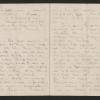
wistful doubt, a yearning in your soul, (as when
your breast asks for my touch),
which I saw at once in your letter; but I felt
sure at once that my letter would quite drive
that away; for did it not come very soon after
you posted to me? So I am quite at ease. And,
as if standing happily alone with my hand in
yours and looking with parallel eyes at a
setting sun from some hill, I can look back
contentedly upon the full-packed hours I have
just spent in Caermarthenshire(sic).
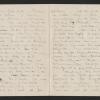
Contentedly! - more than that; for you also
look back upon it with me; you have lived
these hours equally with me.
Do not expect from me a close or orderly
account of what I did. That would mean such
labour that I should describe things which
really did not make a powerful impression on
me. Instead, I will just babble to you the tones
that are still vibrating loudly in my brain. -No,
do not ask for a record; for that would remind
me of how tiny a being I am, how little
sensitive to loveliness and greatness.
Loveliness and greatness - I have seen both in
these two days. I have seen the vale of Towy
and its river, - a flat wealthy plain framed by
sudden wooded hills on every side, all
peaceful, glowing, and peopled by folk of
quite ideal sweetness; that was the loveliness.
The greatness was all the greatness in the
past; for as yet these quiet valleys have no new
greatness, however much people so earnest
and intelligent may do. Greatness of the past!
the castles of Wales! I saw several of them; one
was actually in the grounds of the farm at
which I stayed, its name was Dryslwyn castle.
The farm is called Dryslwyn, and means
Tangled Brakes. Well, these castles called up
very few feelings in me, except such as I fear
have been stolen from reading of [illegible]
like this; still even so, I felt a positive pleasure
in seeing at last what I had only heard of
before. This particular castle was very ruinous,
fragmentary, standing on the edge of a steep
enter this mere [illegible] of my words; otherwise I would talk
merely of my feelings. Tell me, dearest friend, you are not
indignant at such a mere diary? Goodnight now, I will not fail
to come to your side at the happy hour. Do you dream of me
and my embrace? Goodnight.
Sunday
It is a blue bright morning! I have just remembered that
Elaine is only another form of Helen, like Elin, Eleanor, Ellen etc.
And here is your letter! my body still burns with the love that
is in this letter, as it would burn under your embrace. The
letter found me happy, it made me happier, and unable to
admit into the garden of our love
anything but white simplicity and delight; when the
heat of my blood and brain allow me to think, my thoughts
are of admiration and adoration towards you, of wonder
"how you can be what you are", so sweet, so simple, so
passionate; to think of you as my own is too presumptuous
when you see me so lofty, as now. It makes one [illegible]
[illegible] frail and perishable, - we build for the
spirit, poetry. But I am nearly certain it is the thought of
someone else, not my own.
Then we went to Grongar Hill, which is not naturally remarkable,
except in its broad view of the Towy Valley; but of course it
is world famous on account of the poem of Dyer, which you
shall see when I come back. In the distance we saw De Nevers
castle among woods; as the name shows it is Norman. -Some
other day I hope to see this and another castle - Castle Carreg
Cennen, which we did see but only at a distance. - During
this walk we saw the wild apple trees covered with fruit, and
wild plum trees also with fruit quite [illegible] enough to eat.
This was in the morning, today. Last night I drove 8 miles
through the same country to the farm Gwili and I stayed at,
and saw Golden Grove on our way, - merely fine woods of
oak, surrounding the house (1832) of Lord Emlyn, and
containing the chapel once
attended by the famous Jeremy Taylor. The drive ended in
complete darkness, when my feelings were strong but vague,
and yet perhaps a little insincere, since they left room for an
irritation that someone in the company had set me down as
a Londoner, from my behaviours.
Nearly all the evening, till 12, we were singing comic songs
and Welsh lyrics by Watcyn Wyn, Gwili's headmaster at
Amanford, he being only assistant. After a good dreamless
sleep we took the walk I first described -the castles. That was
the morning; after a late dinner we drove at 4 to Llynllechwel,
a large pool with the same legend as Lough Neagh in Ireland
(a horseman rode from a well, forgetting to replace the stone
lid and on turning back saw the water flooding the land, and
stopping at the horse's foot marks). There I thought of you,
sweet heart. The heather was so tall that it would have
reached your baby waist at ten years old; it was covered with
fine pale blossom, with bees at the blossom. It was a billowy
hilltop or plateau, in the sunk centre of which was the pool,
"Howel's lake of the stone", Llynllechwel. Not a tree grew
there, only short furze, and the wind came [illegible] to us
from head the of mountain(sic) and then at last the sea. How
you would have laughed in perfect joy, my own sweet little
one! The day was sunny and windy. I wish I could only have
seen your image crossing these fields. Once indeed last
night, in the failing light, I saw white robes traversing a steep
green field between two woods, only for a moment. I
thought of Elaine of Astolat, of whom I had been writing; -
and I thought of you, Helen! It was a mere glimpse, but it fed
my spirit and lives there still in perfect clearness.
Goodnight now! Come tomorrow and let your eyes and
breath put into my dusty words the life which they sadly
need, -(for I am sleepy). Do you live these hours with me? I
think it is not in vain that I hope your spirit can easily and
joyously
I gave you last night some idea of what we saw, but I did not
say anything about the people. Nevertheless, I kept repeating
what I have said of other Welsh people. I will say little. They
were pious, decent, clean and passionately happy, and this,
too, though they were all orphans at the farm, though they
have seen many troubles, though [illegible] Harris, the pupil
of Gwili's who drove us to the farm and is the only son there,
is delicate and painfully deformed, a hunchback. Besides him,
there were his three sisters, sharp featured, somewhat
refined, spare creatures, of whom the eldest is married to the
man who actually controls the farm. When they spoke
English, they spoke it well, evidently with some knowledge of
English literature. Their Welsh I could not follow, but it was
evidently humorous within comely bounds; and to this was
added that great enthusiasm which is exclusively Welsh, - the
enthusiasm for Welsh poetry; when they sing, it is the songs
of men who have lived near them, who still live there, or who
have known and loved them. There is this about Welsh
poetry so different to English: it is entirely welsh; it refers
constantly to Welsh men, traditions, places, by name, and is
proud of all; whereas English poetry has no such characters, -
except Wordsworth's perhaps. The poetry, too, is all made to
be sung, and is sung. Why! When we were out, two or three
of my companions were always singing a Welsh hymn or
song, and so heartily and seriously; moreover all know
the songs the others know. And the tunes! these songs of
Watcyn Wyn's were all sung to the tunes of old Welsh airs,
which have a common but inexpressible charm; they are just
a little melancholy, yet sprightly like a pattering dance. When
I come back, I shall bring with me a copy of this book,
containing the music also. "The Maids of Caermarthen" and
"the Girl of Llandebie" are delightful; and I mutter all day the
tune of "Tra bo clochty yn y pentre", which is "while the belfry
in the village"; then I forget the rest, but the substance is,
While the belfry in the village [illegible] the
countryside, I will love the maid of Llandebie. In this, too, he
talks of the "Lwchwr laches", the bright Loughor, which is the
river that flows a quarter mile from here - pronounced Loo -
choore (guttural ch). You see the character of them. They are
simple and truly homely, since they are all above the home of
the poet. Yet I dare say their poetic value is not greater than
English poetry nowadays; only it is simple, less ambitious,
and of course sounds stranger (and I hope strange to me in a
strange tongue; then also it has the advantage of music,
which few English verses have. These men, too, Helen,
something like you, are living lives greatly in accordance with
their powers, yes! and with their desires, probably. Or is it
that I know more of Welshmen than English and have passed
over the successes of the latter? Certainly I think a poet,
especially a lyric poet, has an infinitely greater chance here
than in England, a greater chance of perfection in his art and
in his fame; I myself, if only I were greater, might lament
jealous of death - or at least of time - that I cannot so live
with you that you could develop in their completeness all the
capacities of your nature; if we could so live, I think you
would be the loveliest human picture in the world. Meantime
you will live always happily in that [illegible] and [illegible]
country. You tell me much of it, but never too much, -and if I
were not so grateful for your devotion all this week, I should
say, - never enough. And you have not yet shown me the
flowers you do not know.
Somehow I always think of you as living a life perfectly in
accordance with the faculties of your nature and each "in
harmony with" what we call nature. And that you are able to
live thus seems to prove over again the worth of purity;
because it must be your purity, of course combined with the
tenderness of your nature (which purity helps, if it does not
actually create), that makes you thus, since I cannot suppose
you to be endowed with any unique quality by nature. But
this is enough. I say it nevertheless because I feel how
incomplete is the activity of my natural faculties.
In life I am your truest fondest friend Edwy and you ever my
own sweet little one Helen, Helen coflaid, Helen bach, "little
Helen", as I shall call you in Welsh; for all friends call
themselves "bach", -"little Evan" [illegible] old sweetheart
called my old uncle when he met him after the long separate
years - I told you of him, - the American uncle who is to
marry again in his age. My anemone maiden Goodbye. I am
all and ever yours. Sweetheart Goodbye
I came to London to be born, Certainly my present writing
would have given me a sort of name if written in
Welsh; even in English I might do something by writing,
Wales. At present, however, I have no impulse at all. Yet you
might ask why I do not write of Grongar Hill, a subject very
acceptable to the newspapers etc. The fact is I could see
nothing exceptional in it; what little was remarkable I did not
understand - a [illegible] broken rampart on the top.
So it would be fearful journalism to attempt it. besides, I
think I have nothing new to say about a poem so often
criticised as "Grongar Hill". Its value is in its superiority to and
difference from the writing of his time - the time of Pope. -
Goodbye now to the Towy valley. Time always mellows my
impressions if they are at all strong, so I may yet please you
by some more artistic account than this, of which most
is by nature:, as much by manner unsuitable for permanence;
it is a little dreary, since I write for you. Goodbye to you soon,
sweet heart for though I am performing a duty as well as a
pleasure in this I have other duties, duties to my muse and to
Lord [illegible] "Advancement of learning" etc.
I am sorry Watteau was so uncongenial. It only adds to my
mystification by Pater's character. That he could enjoy such
a man? He can enjoy it because he is an artist, to whom the
subject is nothing, the execution everything, I think. Anything
can be noble in a powerful hand. Still you are not an artist,
but a simple [illegible] woman whom such things ought not
to delight.
I have not heard from Irene, nor from Mrs Noble, nor from
[illegible]; neither have I seen the Speaker and my last article,
so I suppose I have let it slip by, a pity.
The thunder storm was terrible in this valley but none of us
suffered from it.
I heard from Mother, who said lately she had seen you only
once since I left home.
Goodbye now! and let tonight be a [illegible] night for you. I
would give you any pleasure you and love craves, a kiss or a
moaning embrace, limb to limb, bodies locked, [illegible]
mixed. Shall we so sleep? when shall we? My body craves it
now. But wait. Goodbye. My kiss would be happy and
healthy. Take this heather; we will sleep with petals asside(sic)
our limbs. I fancied just now I would buy a fair cloth of silk on
which we should lie together some day. Shall I?

More items with these tags
Contact Us
To request take down or report racist, offensive or otherwise harmful content.
You must be logged in to leave a comment