17 Mar 1904, Bearsted Green
Description
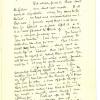
Letter from Edward Thomas to the poet Gordon Bottomley. Sent from Bearsted Green, Maidstone, Kent. Archival ref: 424/1/1/1/10/12
Bearsted Green
nr Maidstone
17.iii.04
My dear Gordon,
Is is not easy for me to think about
the future, even about next month. It all
seems to improbable & every day seems to be
the last, so tired and unconcentrated am I.
But now I promise myself that I will leave
here for Cartmel on or about April 13 or 11.
It is most pleasant to think of, & I thank
you & all yours for asking me. You know I
am no traveller. I am always wanting to
settle down like a tree, forever. But I have,
except my body & clothes, already spent so
much life at Cartmel that I feel I am not
untrue to myself in taking them as well. You
will let me have an hour or two a day for work,
won't you? It may be quite unavoidable.
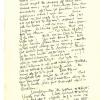
You will find me, I fear,
somewhat hard of speech & hearing in the
matters you & I really care about. For all
my life I have been i the hands of those
who care for other & even opposite things; &
they have tried to teach me - or by my
own imitative nature I have tried to learn - to
say much & smartly about things I care
nothing for. Perhaps after all they are
the only things one can ever sum up &
be satisfied with in conversation. And this
reminds me of what you say about your own
isolated positions away from fellow artists.
I know well the desire & the apparent need;
for work that depends always & entirely upon
a man's own invention & impulse always
let the artist down into deep waters of
misery now & then., & at those times
I have sought the company of many and
various men, & yes I have always been alone
& unaided; all I have got from them has been
experiences which I never use. I have
tacked my soul empty to a man who (as I
had not the wit to discover) answered me
with his tongue; not one man, but a score:
I suppose, as I hinted just now, that my
lack was obscure - in 'clouds of glory'
if you like. Well, are you likely to have
better luck? Your work seems to me to be
a far lonelier flows than mine, & another
artists might change you or swamp you,
but couldn't help you to develop - I think-
for the more health of the brain, a variety
of social intercourse should be good: & I
wish you were able to try it. But with me,
social intercourse is only an intense form of solitude,
and as solitude is what I have to avoid, the
means are yet to be found. Does this un-
comfortable falls comfort you all? But
your poor wrist - that is worse than all my ills.
It is horrible, plain fact that might appal as
Berkleian.
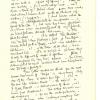
I am glad if you like 'the rapture of the fight'.
I hardly ever do. I look forward to writing
& look back upon it joyfully as if it were an
achievement & not an attempt - very often.
But while I write, it is a dull blindfold
[illegible] through a strange lovely land; I seem to
take what I write from the dictation of someone
else. Correction is pleasanter. For then I have
glimpses of what I was passing through as I wrote.
This very morning the sun was shining, wide &
pale gold & warm as it has done for two weeks, &
the church bells suddenly beginning to ring were
at one with it apart of Spring, & they set
me writing; for I could not go out, as I
have a touch of Helen's illness & am over weak;
but at one, I became dull with the dulness of
ecstasy ( I suppose). I don't know what the
essay - which pretends to be an episode - is
going to be like, but some day I may publish
a volume & give an essay to each of my friends,
as Lionel Johnson did with her verses, & this
shall be yours. It is called 'The Skeleton'
& is (roughly) two pictures: first a beautiful,
many-sided youth in Spring, & next his skeleton in
Autumn. & I, or the teller of the story, have
murdered him. It is so simple in scheme that
it will be difficult to make it effective. Also, I
am hampered by my long silence. For I have
accumulated so much material that I am tempted to
use too large a part of it.
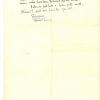
Your letter makes me think you do not
know how much of 'Oxford' is imaginary. Only
one of the dons is taken from life, & he is
the one like William Morris: the original is
F. York Powell, a distant cousin of mine, as I
have just discovered. The college servants are
all imaginary: so are the undergraduates &
except the one who 'achieved everything but success." Of the College Garden only a
fragment is visible & that is Wadham Garden.
Philip Amberley (are you sorry?) never
lived & never died & never taught me this
easy script - which is descended from
a style founded on a 14th or 15th century monkish
hand & sometimes used by a brother
of mine who has been trained as an artist.
Helen is just back & looks quite well.
She and I send our love to you all.
Ever yours
Edward Thomas

More items with these tags
Contact Us
To request take down or report racist, offensive or otherwise harmful content.

You must be logged in to leave a comment