8 Jan 1903, Rose Acre


Description
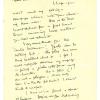
Letter from Edward Thomas to the poet Gordon Bottomley. Sent from Rose Acre, Bearsted Green, Maidstone, Kent. Archival ref: 424/1/1/1/10/7
Rose Acre
Bearsted
nr Maidstone
8.i.03
My dear Gordon Bottomley,
I hope you
won't mind my adding a
newspaper column with your charm-
ing beam verses. Here is the best
leaned extract from a frost bound
brain, concerning house mottoes:
you need not return it.
Very many thanks for the
"united Irishman". Years can do
nothing bad, & the play had some
thing excellent about it & yet I
could not quite overcome my surprise
at finding a justice of the peace among
the characters. As a play (I
am not a playgoer, & have only
been to a theatre six times) I should
think it was good.
I have at last found a space
of leisure. Forgive me for dedicating
its to literae instead of letters.
With our love-
Edward Thomas -
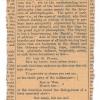
Daily Chronicle
8.i.03
See previous letter G. B.
WORDS OF THE HOME [crossed out]
"House mottoes and Inscrptions, Old and New"
By S. F. A Caulfield (London: Elliot
Stock. 5s)
Many have become transcendental concern-
ing clothes; few concerning houses. Yet a
house is a perdurable garment, giving and
taking of life, many-pocketed as Panurge's in
Rabelais. If it only fit, straightway it begins
to chronicle our days. It beholds our sorrows
and our joys; its untalebearing walls know
all our thoughts, and if it be such a house as
grows after the builders are gone, our
thoughts presently owe much to it; we have
but to glance at a certain shadow or a curve
in the wall-paper pattern to call them,
softened as by an echo, and that corner or that
gable starts many a fancy that reaches beyond
the stars, many a fancy gay or enriched, with
regrets. It is aware of birth, marriage, and
death; and who dares say that there is not
kneaded into the stones a record more pleas-
ing than brass? With what meanings the
vespral beam slips through a staircase window
in autumn! The moon has an expression
proper to us alone, nested among our lines,
or heaving an ivory shoulder above the neigh-
bour roofs. As we enter a room in our house
we are conscious of a fitness in its configura-
tion that defies mathematics. Rightly used,
such a place will inspire a stately ordering of
our lives; it is, in another aspect, the amplest
canvas for the art of life. It becomes so much
a part of us that we exclaim, with the dead
Swiss, quoted in this book:-
This beautiful house is sand and stone:
What will it be in heaven?
Even Elwes, the miser, had a sense of this.
When his guest explained that after long
search he had found a corner where his bed
could not be reached by the rain, he cried:
"Ah! you found it! it is a sweet corner, is it
not?" Thus a house builds up its personality
out of us, and we forsake it at our peril-
Thou within thy gate
Art of thyself so delicate-
since we must begin life anew and maimed.
How tinged with "that older piety" are
the grey walls behind the hedge or moat or ha-ha,
near London and in the recesses of the land.
"This land" - so run the 'beam-verses' of a
living Lake poet:-
This land was once the Northmen's rest,
And here the Virgin's house was blest
With a sweet peace through lost years wrought-
O, in these weary years of nought,
May we who now this hearth-fire light
Learn somewhat of that old delight,
Which, cherished in this drowsy grange,
Shall help the outworn word to change. G. B.
And we have seen this vers of Spenser in-
scribed around a tranquil room overlooking a
silver half-moon of the Thames:-
Sweet Themmes! runne softly til I end my Song
In such a house existence flows at a wise pace.
So, though most house-mottoes are but poor
translations out of silence, an annotated an-
thology should have been a pleasant thing,
had it been laboriously prepared by one ac-
quainted with English, the language in which
it is written, and with Latin, a language often
of necessity used. They might seem to be
little more than variations up "Casa mia,
casa mia"' yet to the understanding lover
they are a part of the honest autochthonous
philosopy that exists mainly for the diver-
sion of anthropologists. The spirit of early
ages - i.e. of the mass of mankind, who live without
reading or writing of living - is per-haps more adequately expounded by house-mottoes and epitaphs and the like than by
the proud logic of philosophers. The Odyssey
is but a home-coming, the Aeneid a "change
of address." And in this book and over the
hearth and doorways of all lands we may read
lyrics that are footnotes to the Aeneid and
the Odyssey - breathing hope, confidence,
fear, gratitude, defiance, hospitality, mirth,
or such fierce homeliness as this-
Oh! holy St. Florian,
Save my house; burn others down-
or such facetious welcome as this over the vil-
lage shop-
To patronise us pleases you and us-
or the facile piety of the millionaire-
East or West
Home's best-
or the monition round the dining-room of a
brief convivial club-
Not wisely, but too well.
Is it because we are unimaginative or indif-
ferent that we now write "Fair View" in-stead of a system of philosophy over our
doors? Or are the dwellers in rows of a hun-
dred villas, each containing a pianist or voca-
list, too refined to write up sentiments that
must be so different from the Greek poet's,
"A neighbour is a great thing for a neigh-
bour"? Or have we at last acknowledged the
ineffableness of home, so that, in the words
carved within a solemn library, "We demand
gold silence or golden speech," choosing to
let the flames write their legend on our ceil-
ings and the stones cry out from the walls?
No motto on a dial was ever so eloquent as
the dial itself. One who had learned that was
a pious aged gardener who on his deathbed
saw heaven with closed eyes; and, but for the
forms that moved therein, la! it was his own
house, and around it lilies, columbines and
roses, and the sun dial revealing no hour in
that great light.

More items with these tags
Contact Us
To request take down or report racist, offensive or otherwise harmful content.

You must be logged in to leave a comment