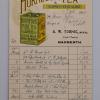
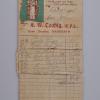
Bill from A W Toohig, Cash Chemist, Narberth
Description
Bill for items bought from A W Toohig, Cash Chemist, Narberth dated 1914 to Mr James John, Narberth for items including sugar and invalid Bovril, purchased between 5 June 1912 and December 12 1913 for 14/9d. Bill head shows the name of A W Toohig and advertisement for Horniman’s Tea which includes a picture of a tea packet, printed in green, yellow and black. This showed the importance of tea in daily British life.
Albert William Toohig’s parents ran the Plough Inn in Narberth. He was a member of St Andrew’s Church in Narberth and died in 1940 at the age of 70. Toohig’s Cash Chemist was located at 39 High Street. The premises retained its connections with pharmaceuticals, later becoming Heritage Pharmacy and is now the location of Lloyd’s Pharmacy. Cash chemists are rooted in the practice of providing affordable healthcare solutions to the working class.
The growth of the sugar and tea industries have links to British imperialism. British sugar was one of the most important imperial products. It was mostly grown in the West Indies. Before 1834 sugar was produced by enslaved labour. After abolition, British plantation owners used a mixed of indentured and free Black workers. Tea, once a luxury item, had become so engrained in British society that it was considered a necessity, even for the destitute. Tea rose in importance with the Temperance Movement in the 19th century and items such as this show the importance of tea and cocoa in the anti-alcohol stance. In 1882 tea-loving Prime Minister William Gladstone told Parliament “The domestic use of tea as a powerful champion able to encounter alcoholic drink in a fair field and throw it a fair fight.” The Dutch started to import tea in the 16th century – it spread from there to western Europe but remained a drink for the wealthy. Catherine of Braganza, wife of Charles II, made it fashionable in the UK. The East India Company seized on this and began to import tea into Britain, shipping it from Java.
The East India Company (founded in 1600 and who had begun using and transporting enslaved people in Asia and the Atlantic in the early 1600s) had the monopoly on all trade from the East. When tea came into Britain, their ships transported it and by the 18th century tea had replaced spices and silk as their most important cargo. By 1760 they were carrying 4.5 million tons a year into Britain. It had a high tax due in part to smuggling and tea was often adulterated with substances such as sheep dung to give it the necessary colour. William Pitt the Younger reduced the tax on tea in the 1784 Commutation Act, acting on advice of Richard Twining of Twining’s Tea Company (who were importing through the East India Company who had gained control of large parts of the Indian sub-continent where they initiated the beginnings of the British Raj and Hong Kong) making legal tea affordable. The trade in tea helped to strengthen and promote British Imperialism in Asia. Increase in popularity was also in a major part to sugar.
Increase in sugar consumption led to more tea and increased the enslavement of African people multi-fold in the West Indies. By 1760s the annual duties on sugar imports were enough to maintain all the ships in the navy – a navy that helped to secure British dominance overseas. So, the increase of trading in enslaved people grew. Due to the increase in plantation agriculture, tea drinking also changed the economy and ecology of areas of India and Ceylon (Sri Lanka). The original tea trading and blending business 'Horniman's Tea Company' was founded in 1826 in Newport, Isle of Wight, John Horniman. In 1852, he moved the company to London to be closer to the bonded warehouses of London Docks, then the biggest tea trading port in the world. Until 1826, only loose leaf teas had been sold, allowing unscrupulous traders to increase profits by adding other items such as hedge clippings or dust. Horniman revolutionised the tea trade by using mechanical devices to speed the process of filling pre-sealed packages, reducing his cost of production and hence improving the quality for the end customer. This caused some consternation amongst his competitors, but by 1891 Horniman's was the largest tea trading business in the world. Friedrich Nietzsche once mentioned in private correspondence that it was his favourite tea.
In the 1870s, the business was taken over by his son Frederick John Horniman (1835–1906), who invested much of his fortune for social purposes. An avid collector, he founded and built the Horniman Museum in London to house his various collections. In 1918 Frederick's son, Emslie Horniman sold the business to J. Lyons & Co., who moved production to their new factory in Greenford, Middlesex, in July 1921,

More items with these tags
This item also appears in


Contact Us
To request take down or report racist, offensive or otherwise harmful content.
You must be logged in to leave a comment