Middleton Hall Excavation - Trench III (3) 2011
Description
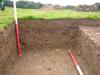
Once archaeological features began to emerge, it was decided that further investigation of the southern bank would provide further evidence for how this feature was constructed. An archaeological section or what is often referred to as a ‘sondage’ was excavated, its purpose was to reveal the nature of deposits and reveal how the bank was constructed and the material it was made up of (Barker 1982). The sondage was excavated by putting in a string line (a piece of string attached to two nails) measured exactly 1m from the eastern trench edge in width and 2m in length. The sondage was located in the south-east corner of the trench. The depth at which the sondage was taken to was flush to the bottom of the trench to that of the excavated depth of the infill sediments of the water feature (Austin & Dollery 2011). While excavating this area two phases of bank construction became visible and could clearly be seen in the section. Below the gravel path there was a high concentration of red clay which contained a mixture of sub-rounded stones. Below this layer there was a clear division or boundary where the red clay stopped and a grey clay began (Austin & Dollery 2011). The grey clay contained a mixture of rounded stones of various sizes and it has been interpreted that this context could be the natural boulder clay that caps the solid geology of the area.
In this photograph of the sondage, looking south, you can faintly see the divisions of three different context. To the top of the section near the turf, there is a medium brown that has little to no stone. Below that there is a subtle change and the section becomes a lighter brown clay, the most notable change being where more rounded stone can be seen. Blow this at the very bottom of the section, you may be able to make out the faint colour differences where the light brown stops and a grey clay begins. This is likely to be the natural boulder clay for the area. The light brown clay was probably used to create the bank, both clays are impervious to water therefore allow for the retention of water.
Austin, D. & Dollery, J. The Excavation. In Austin, D [Ed] 2011 Paradise Lost In Search of a Garden before the Garden: Middleton Hall. Report of project conducted in 2011. Heritage Lottery Fund
Barker, P. 1982 Techniques of Archaeological Excavation. London. Batsford

More items with these tags


Contact Us
To request take down or report racist, offensive or otherwise harmful content.

You must be logged in to leave a comment