Pembrokeshire Panel
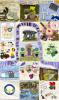
Description
Although many of the campaigns in the 1970s continued to focus on rural life, resolutions affecting wider issues were also passed. In 1974 the greatest number of WIs ever was recorded, at over 9,000.
Looking at the panel, fairly near the centre is the cromlech Pentre Ifan, near Newport, Pembrokeshire, in appliqué and embroidery. The timeline running around the panel in string patchwork encompasses the various events and campaigns illustrated on the panel.
At the top of the panel, in the centre, the 1974 resolution urging ‘the government to institute a national policy to co-ordinate and develop the reclamation, recycling and re-use of ingredients in
domestic and industrial waste’ is featured in collage and appliqué.
To the left and right of this, are depictions of a resolution in 1977, urging the government to give greater priority to research into alternative energy sources and in 1978, an NFWI conference ‘Energy Today and Tomorrow’, was held in conjunction with other women’s organisations. Discussions centred on the prospect of diminishing fossil fuels and the need to gradually replace
them with corresponding amounts of alternative, rather than nuclear energy. The large industrial
chimneys and mine shaft represent ‘Energy Today’ using machine embroidery, and the familiar sight of wind turbines, solar panels and the energy of the sea representing ‘Energy Tomorrow’, are in machine embroidery and needle felting. To the left of the cromlech, the cross stitch gender symbols for the male and female focus on Anglesey Federation’s resolution in 1972 urging all local authorities to provide mandatory rather than permissive free family planning. To the right, a major craft exhibition Tomorrow’s Heirlooms, inspired by Laura Ashley, was held at the Commonwealth Institute in London, here using a range of techniques including appliqué, rag rug making, patchwork and cross-stitch.
Below this is the Powys Radnor Federation Field Names Projectwhich ran to 11 volumes and won
the Prince of Wales’ Countryside in 1970 award in European Conservation Year. The volumes have been worked in appliqué and embroidery.
Centrally, there is a photographic image of Denman College using an iron-on T shirt transfer with
appliqué, and patchwork flip and stitch and embroidery. This illustrates the opening of the Teaching Centre and Brunner Buildings at Denman College by the Queen Mother in 1970. Just below and to the left, the kitchen, in appliqué and embroidery, illustrates the opening of the Home Economics Centre by the Queen in 1979.
Having passed a resolution in 1972 asking for ‘high priority’ to be given to ‘the provision of nursery
education for all children’, the NFWI became a member of Fair Play for Children. Its policy was to set up play councils throughout the country. The children’s toys provide a colourful scene with
techniques such as appliqué, tapestry and embroidery.
The appliquéd and embroidered section on the right of the panel, here represented by Pembrokeshire’s Preseli Hills, suggests the Diamond Jubilee exhibition in 1975 held by NFWI
entitled This Green and Pleasant Land. The exhibition reflected over environmental issues and raised the question of the future of the countryside. Also on the occasion of the WI’s Diamond
Jubilee, Presidents from every WI were invited to a Buckingham Palace Garden Party, and we can imagine the array of hats that were on display with these appliquéd and embroidered hats with Buckingham Palace in the background. The invitation is in calligraphy on vellum.
Bottom right of the panel features a two year project with Kellogg’s; Good Health is Good Fun, which highlighted problems of obesity. In support, a Buckinghamshire member walked 259 miles to
Liskeard in Cornwall with her black Labrador. The panel has been completed in appliqué.
In 1978 a resolution expressed the members’ ‘deep concern of the dangers to marine life from over exploitation and pollution’, and urged that the ‘effect of these should be more closely monitored
and controlled internationally’. This scene in needle felting symbolises some of the many features which make Pembrokeshire special.
The Pembrokeshire badge is appliquéd and embroidered. It shows the Tenby daffodil, embroidered in long and short satin stitch, in the centre. Either side of it is the WI tree. The blue circle has ‘Pembrokeshire’ across the top and ‘Sir Benfro’ at the bottom, embroidered in silver thread.
This item also appears in

Contact Us
To request take down or report racist, offensive or otherwise harmful content.
You must be logged in to leave a comment