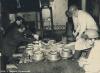
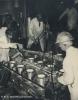
Workers with protective clothing at Rheola Works, Glynneath, 1981
Description
Workers inspect aluminium cast at Rheola Works factory.
External source:

This item also appears in


Contact Us
To request take down or report racist, offensive or otherwise harmful content.
Comments (2)
Submitted by Martyn Leonard… on Fri, 19/01/2024 - 11:06
British Aluminium had a Research Department at Chalfont Park in Buckinghamshire that developed processes ( including DC casting technology) for the production plants elsewhere in the UK. There was spare casting capacity at British Aluminium Rolled Products at Resolven, and so a team of white coated engineers & metallurgists from Chalfont Park would descend on the Rheola Factory for two weeks or more to help commercialise a casting technique for use elsewhere. Chalfont had a 7t furnace only with a single strand casting pit. Rheola Foundry had 22t melting furnaces with 11-14t holding furnaces.
Here we see the "white coated" Chalfont staff supervising the start up of a cast of eight extrusion billets of 6-8" in diameter using a technique known as level pour. The Rheola "union" staff would deliver the hot metal to the pit and then leave the "white coats" to cast it. At the end the Rheola Foundrymen would strip the casting pit of the billets ready for the next drop.
Submitted by Martyn Leonard… on Fri, 19/01/2024 - 11:11
British Aluminium had a Research Department at Chalfont Park in Buckinghamshire that developed processes ( including DC casting technology) for the production plants elsewhere in the UK. There was spare casting capacity at British Aluminium Rolled Products at Resolven, and so a team of white coated engineers & metallurgists from Chalfont Park would descend on the Rheola Factory for two weeks or more to help commercialise a casting technique for use elsewhere. Chalfont had a 7t furnace only with a single strand casting pit. Rheola Foundry had 22t melting furnaces with 11-14t holding furnaces.
Here we again see the "white coated" Chalfont staff supervising the start up of a cast of sixteen extrusion billets of 7" in diameter using a twin launder level pour hot top system. The hot top level pour system reduced the amount of scalping required on the billet relative to a traditional dip tube and float system of level control. It also greatly increased productivity by increasing the number of billets that could be cast simultaneously. This system went on to be used at both the British Aluminium tube plant in Redditch and the High Duty Alloys Plant in Distington, Cumbria.
You must be logged in to leave a comment